
Body Language That Commands Attention
Your gestures and posture communicate before you say a word. Learn which movements strengthen your message and which ones distract.

Your gestures and posture communicate before you say a word. Learn which movements strengthen your message and which ones distract.
You’ve probably heard it before: “It’s not what you say, it’s how you say it.” But here’s the thing—your body says plenty too. In fact, research suggests that up to 65% of communication happens nonverbally. That means your posture, gestures, and facial expressions are doing heavy lifting while you’re talking.
The good news? You don’t need to be naturally charismatic to master body language. It’s learnable. We’ve worked with hundreds of presenters, and the ones who see the biggest improvements aren’t the most naturally confident—they’re the ones who understand what their bodies are actually doing. Some people slouch without realizing it. Others fidget with their hands constantly. A few folks lock their knees and sway. Once you know your habits, you can fix them.
This guide walks you through the techniques that actually work. You’ll learn which gestures amplify your message, how to position yourself for maximum impact, and what to avoid if you don’t want to distract your audience.

Posture is everything. It’s your foundation. When you stand tall with your shoulders back, you’re not just looking more confident—you’re actually feeling it. That’s not psychology; it’s physiology. Your body position influences your brain chemistry.
Here’s what strong posture looks like: Feet about shoulder-width apart. Weight balanced evenly. Shoulders relaxed but pulled back slightly. Chest open. Head level—not tilted down (which makes you look uncertain) or tilted back (which looks arrogant). You’re aiming for that 10-degree forward lean, which signals engagement without aggression.
Most presenters don’t realize they’re doing these things wrong. You might be locking your knees, which cuts off blood flow and makes you sway. Or you’re leaning on one leg, which shifts your weight and creates an awkward stance. The swaying thing? It’s incredibly common and incredibly distracting. Your audience watches your body bounce instead of listening to your words.
Practice this: Stand in front of a mirror for 2-3 minutes. Record yourself on your phone. Watch it back. You’ll see immediately what you’re doing wrong. Most people notice within the first 30 seconds of watching themselves that their shoulders are hunched or they’re shifting their weight constantly.


Your hands are tools. When you use them right, they amplify what you’re saying. When you use them wrong, they undermine it. The key difference? Purposefulness. You’re not waving your hands randomly—you’re using them to emphasize, point, or clarify.
Open palm gestures are your friends. When your palms face upward or outward, you signal honesty and openness. People trust open palms. They believe you more. Closed fists or pointing fingers? That’s aggressive. It puts people on the defensive. You want them leaning in, not leaning back.
The sweet spot for hand height is between your waist and your shoulders. Hands too low look weak. Hands too high look manic. You’re aiming for that middle zone. And here’s something most people don’t think about: your gestures should match the scale of your idea. Big concept? Bigger gesture. Small detail? Smaller gesture. The physical scale mirrors the intellectual importance.
Common mistakes we see all the time: People who keep their hands in their pockets (looks nervous and closed off). People who grip the podium so hard their knuckles turn white (looks tense). People who gesture with one hand while the other hangs dead at their side (looks unbalanced). Symmetry matters. If you’re making a gesture, both hands should participate unless you’re intentionally making a one-handed point.
Here’s what separates average presenters from great ones: they know when to plant themselves and when to move. Movement’s a powerful tool, but only if you use it intentionally. Pacing back and forth constantly? That’s nervous energy. Your audience feels it. They’ll focus on the pattern of your steps instead of your message.
Move when you’re transitioning between ideas. Stay planted when you’re making a crucial point. This creates rhythm and keeps people engaged.
When you do move, move with purpose. A few steps to the left. A few steps to the right. Deliberate. Controlled. It shouldn’t look like you’re trying to burn off anxiety. Most presenters don’t realize they’re unconsciously swaying or pacing—it becomes background noise that distracts from what you’re actually saying.
Distance matters too. If you’re too close to your audience, you invade their space and make them uncomfortable. Too far away and you seem distant and cold. In a room setting, you’re aiming for about 4-6 feet from the closest audience members. In a large auditorium, the stage naturally creates that distance.
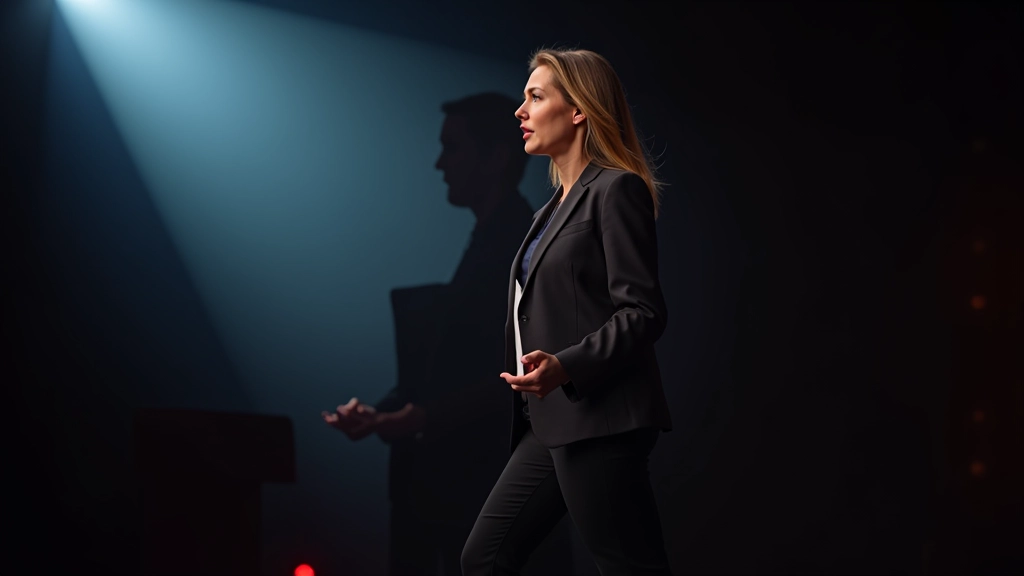

Your face carries more weight than you think. People read faces constantly. They’re checking for authenticity. Are you really engaged or are you faking it? Do you actually believe what you’re saying? Your face either confirms or contradicts your words.
Eye contact is non-negotiable. Not staring—that’s creepy. But genuine eye contact with different audience members, rotating through the room, creates connection. When you avoid eye contact, you signal uncertainty. People don’t trust speakers who won’t look at them. Aim for 3-5 seconds per person. That’s enough to register genuine connection without feeling like an uncomfortable stare.
Your smile matters, but it has to be authentic. A forced smile looks worse than no smile. People can tell the difference in about 200 milliseconds. A genuine smile involves your whole face—your eyes crinkle slightly. That’s what people respond to. You’re not trying to be a game show host grinning constantly. You’re smiling when something’s genuinely worth smiling about.
Eyebrows and mouth movement add expression and keep your face animated. A totally flat expression reads as disengaged. Your eyebrows should move when you emphasize points. Your mouth should move naturally as you talk. This isn’t about exaggerating—it’s about being fully present and letting your natural expression show.
These aren’t complicated. They’re just intentional. Practice each one for a full presentation and notice what changes.
Pick a spot to return to. You move during transitions, but you come back to this spot for important points. It creates visual consistency and gives you an anchor when you’re nervous.
Make the same gesture three times when emphasizing a key point. Say the point, gesture, repeat the point, gesture again, state it once more, gesture a final time. Repetition locks it into memory.
Feet shoulder-width apart, weight distributed evenly, chest open. Hold this position for your opening statement and your closing statement. Bookend your presentation with strength.
After you say something important, pause and make eye contact with the audience. Hold the pause for 2-3 seconds. This silence is powerful. It lets your message sink in.
Every 30-45 seconds, return your hands to neutral position (at your sides or clasped in front). This prevents mindless gesturing and gives you a reset point for the next emphasis gesture.
You can’t just know these techniques—you’ve got to practice them until they feel natural. Here’s how most people get it wrong: they memorize the rules and then think about every movement during their presentation. That doesn’t work. You end up looking robotic and stiff.
The right way is repetition until it’s automatic. Take a 5-minute section of your presentation. Practice it 5 times in a row, focusing on one body language element at a time. First run-through, focus only on posture. Second time, add purposeful hand gestures. Third time, add eye contact and facial expression. Fourth time, add movement between points. Fifth time, put it all together and just present naturally.
Record yourself every single time. Watch it back. Most people feel shocked when they see themselves. The things that feel enormous in your body (like swaying) look subtle on video. The things you don’t notice (like touching your face constantly) are immediately visible when you watch. Video feedback is brutally honest and incredibly useful.
By the time you’re in front of a real audience, these techniques should feel like second nature. You shouldn’t be thinking about them. Your body should just do them. That’s what repetition creates—automatic confidence.

Here’s what we know from working with hundreds of presenters: the people who improve the most aren’t the ones with the best material. They’re the ones who understand that delivery matters just as much as content. Your body language either amplifies your message or contradicts it. There’s no neutral.
Start with one technique. Pick the power stance or the pause and look. Use it consistently in your next presentation. Notice how people respond differently. They’ll lean in more. They’ll ask better questions. They’ll remember more of what you said. That’s the power of intentional body language.
You don’t need to be naturally charismatic. You don’t need to be an extrovert. You just need to be aware of what your body is doing and willing to adjust it. Most people have never thought about these things before. That means you’re already ahead of the curve just by reading this.
This article provides educational information about body language techniques for public speaking. Everyone’s communication style is different, and what works for one person might need adjustment for another. These are guidelines, not rigid rules. Pay attention to your audience and your own comfort level. If you’re nervous about public speaking or have specific anxiety concerns, consider working with a presentation coach or counselor who can provide personalized guidance. The goal is to help you communicate more effectively, not to make you feel pressured to perform in a certain way.

A step-by-step practice routine that gradually builds confidence. Most people see real improvement in 3-4 weeks.
Read More
Master breathing techniques and pacing methods that make you sound more authoritative and engaging. These skills take about 2 weeks to develop.
Read More
Structure your presentations like stories instead of bullet points. This method makes your content more memorable and compelling.
Read More